Raibow

Raibow
Rainbow over Galileo Lane, Tucson

Tuesday, March 17, 2020


Reading Researcher and Founding Father of Whole Language.
Ken Goodman, Professor Emeritus at the University of Arizona, died peacefully in his sleep on March 12, 2020 at the desert oasis home that he shared with his wife Yetta Goodman.  Ken was 92 years old.  Ken joined in Yetta’s 89th birthday celebration on March 10.  His last days were full of love, laughter and the sounds of family, surrounded by daughters Debi (Cheryl), Karen, and Wendy (with the memory of Bob); grandchildren Eli (Marcy), Reuben (Retsina), Aaron (Julie), Shoshana (Justin), Josh (Kayleen), Noah, and Rachel; and fourteen great-grandchildren (Julia, Ezrial, Juliette, Madison, Levi, Arabella, Austin, Camilla, Kennedy, Isaiah, Shirley, Michaela, Guinevere, and Ava). 
Ken and Yetta Goodman celebrated their 67th wedding anniversary on June 15, 2019—partners in life and partners in their world-changing research on reading.  They were also co-activists, advocating for public schools, for students’ rights to learn, and for the professionalism of teachers.  In their work and their daily lives, they opened their arms, their home, and their family to students, colleagues, visiting scholars, relatives, and friends.  In return, they were loved by educators around the globe.
Ken was a nurturing person who encouraged all around him to grow and flourish, sharing widely his love of gardening and cooking (and eating).  He was a gardener whose thumb remained green throughout his life.   In the fall, he welcomed new U of A graduate students with olive picking parties at the 10th Street house in Tucson and he cured the olives himself. He got his orchids to bloom in profusion the week before he died.  He served tacos in Detroit before they became popular, reinvented crepes that the family called “Grandpa Kenny’s pancakes,” and explored international cooking to honor doctoral students when they finished their dissertations or for almost any occasion.
Ken’s education began at age four in Chicago public schools. He moved to Detroit when he was seven, graduating from Northwestern High School at age 15.  He grew up in an Eastern European Jewish family. His father, Max Goodman, immigrated at age nine searching for the American dream.  His mother, Rose Berman, the oldest in a large family, left school after 8th grade to work in the family store in Dekalb, Illinois. She always regretted not going to high school and instilled a love of learning in her three children – all completed advanced degrees.  As he grew older, Ken’s interest in his family roots deepened.  The children’s book he wrote, The Smart One, is based on Max Goodman’s shtetl life in Smorgon, Lithuania (now Belarus).
Ken’s world view was influenced by growing up among immigrants, by the cultural and political conversations of his older sister Shirley (Goodman) Rapoport and his brother Calvin Goodman, and by union and civil rights activism in Detroit and Ann Arbor. He picketed Briggs stadium because the Detroit Tigers were not integrated.  He worked in Detroit auto plants in the summer as a union organizer. He took off a year from college to campaign for Henry Wallace.
            After attending the University of Michigan, Ken moved to Los Angeles and met Yetta when they were both counselors in Jewish Center summer camps. He finished his BA in Economics at UCLA, earned a Master’s degree in Education and became a junior high teacher. Ken returned to UCLA for his Doctorate of Education, working with John Goodlad.
Ken and Yetta, with their three daughters, moved to Detroit in 1962. He taught at Wayne State University, and founded the field of Miscue Analysis Research, with funded Reading Miscue Research Labs first at Wayne State and later at the University of Arizona. Ken cultivated a community of linguists, educators, teachers, and researchers exploring language and thinking – a field known as pscyholinguistics.  Ken Goodman and Yetta joined the Department of Language, Reading and Culture at the University of Arizona in 1975. In the relaxed Southwest, freed from business suit attire, he adopted his signature bolo ties and matching belt buckles, crafted by local Diné artists.
Kenneth Goodman leaves an unparalleled legacy.  His socio-psycholinguistic transactional theory of the reading process is the most widely cited in the world.  Ken’s research involved documenting readers in a range of communities, languages, and dialects as they read aloud and then retold whole stories.  This methodology supported a growing movement for qualitative research. By analyzing students’ unexpected responses to print while reading (Ken called these miscues), and later, their eye movements as they read, Ken’s research shifted basic understandings regarding the centrality of meaning-making with its dependence on predicting, and the nature of written language.
Goodman’s theory of reading is a practical theory.   It informs theoretical scholarship about written language, and it deeply informs practice.   It provides teachers with an accessible means of learning about their students as readers and a theoretically grounded way of influencing their own teaching.  It encouraged kids to read real books and was responsible for the increasing popularity of children’s literature.  And it was foundational in the theory-in-practice known as Whole Language.
Denny Taylor posted in Garn Press, “By common consent, Ken Goodman was one of the greatest—the greatest—reading researchers of the 20th Century. He was a fearless advocate for teachers and children—an empathetic, moral force—whose reading theories based on his disciplined, systematic and utterly brilliant miscue research have been proved right over and over again. Working closely with Yetta, a giant in the reading field in her own right, Ken Goodman will continue to be a force for good in an increasingly fragile world.”
                                                                                                                        
 Additional information is available at Ken and Yetta Goodman's homepage.
 The Goodman family will be having a memorial service in the spring or summer.  For those who would like to make a donation in Ken Goodman’s honor, please consider the following organizations:
HIAS: Welcome the stranger. Protect the Refugee
Ken and Yetta Goodman’s families came to the US as immigrant refugees from Eastern Europe. From the website: “HIAS works around the world to protect refugees who have been forced to flee their homelands because of who they are, including ethnic, religious, and sexual minorities. For more than 130 years, HIAS has been helping refugees rebuild their lives in safety and dignity.”

(Formerly Whole Language Umbrella)
Ken Goodman is considered the founding father of whole language and was Honorary Past President of the first Whole Language Umbrella board.  LLA is a professional conference of the National Council of Teachers of English. Donations can be designated to supporting the Literacies for All Summer Institute, or to the scholarship fund to send teachers to this summer conference. 
To donate to LLA in Ken Goodman’s honor, click here.

Tuesday, June 14, 2016

Raven Totem


My cruise ship brought me back to Hoonah, Alaska after many years. As I moved along the walkway from the ship I saw a raven sitting motionless staring at me. He did not move a feather as I took this picture.

The Tlingits say:
 If Raven has come visiting you it can mean any number of things.

 Most powerful of all is the synchronicity that Raven assures you is pending.
He is a master of bending and folding time and space so that you are exactly in the right moment at the right time. As a messenger you are reminded that those around you are reflecting back at you the things you most have to learn about yourself.

Know that when Raven appears that magic is imminent. Raven is about rebirth, recovery, renewal, recycling and certainly reflection and healing.

He signifies moving through transitions smoothly by casting light into the darkness

Thursday, April 14, 2016

An Open Letter to Bernie Sanders

An Open Letter to Bernie Sanders                                                   April 12, 2016                
From Ken Goodman
 Kgoodman @u.arizona.edu
http://www.thosegoodmans.net/

Dear Senator Sanders,

Every four years for a very long time (I am 88) a have addressed an open letter to the in-coming President of the United States on the subject of public education. If your background includes any Yiddish (My father was a Litvak) you may understand” Iz helfen vi a toiten bankus” (rough translation “It didn’t help at all”)

Actually, the educational policies of every President, Republican or Democratic in that whole time has been detrimental to the great traditions of public education. I applaud your campaign commitment to free universal higher education. But our elementary and secondary schools are so poorly supported   and the national and state educational policies have so degraded our teachers and public schools that large numbers of students will not be able to go to even free universities.

No aspect of American society is more important than adequate free public schools: safe and inviting places for our future generations under the guidance of professional teachers dedicated to accepting all learners and supporting their growth toward whatever each is capable of achieving. Public schools are the one institution in society with the potential to reach every child.

But the conditions of our nation’s public schools have suffered under financial neglect and open attack. Simply speaking our public schools are the last socialized aspect of American society and that makes them the relentless target of free-market think tanks on behalf of their corporate funders.

In developing nations , education exists at three levels: Those who have the means pay for private schools which vary in quality in proportion to their price. Public schools serve mainly the working poor. And large numbers of children of poverty are not in school at all or leave after one or two years.

That’s the goal of the anti-public school campaigns in this country. Big business sees no need to educate any more than a small elite group of technicians and managers to run the increasingly digitized production lines. Why pay taxes to educate anybody else? And besides too much education and literacy produces trouble makers. But they also want to control the curriculum and methods of education. And while they are at it they would like to earn profits on texts and tests. Lots and lots of tests.

Laws disguised as reforms, such as No Child Left Behind where really designed to assure the failure of public schools by imposing archaic curriculum, absurd testing, and unattainable criteria for judging school success.

No Child Left Behind was successfully sold to the minority communities as reform intended to help their children. In fact, it was a calculated attempt to make public education appear to be a failure. It used a punitive approach, setting unattainable goals and then punishing the staff and school districts for failure to achieve them. Many schools had entire faculties dismissed and the school turned over  to  for-profit charters or contractors who employed uncertified teachers. In Philadelphia, Detroit, Oakland, and New Orleans among other urban cities the entire school systems have been taken over by the state losing any local input. Then the schools have gotten worse.

But the only way to make profit running these charter schools is to raise class size, reduce services, and replace teachers with machines and less qualified personnel.

At no time in our history have teachers been so poorly treated. The United States has the best educated teachers in the world, but they are  constrained from doing what they know how to do and they are blamed for poor results while teaching in decaying sometimes dangerous schools with inadequate materials. Many fine teachers are driven out of teaching within the first five years in the classroom.

Teachers are so poorly paid that they often need food stamps to put food on the table for their own families. It is no exaggeration that many retired teachers are still paying off their student loans.

Many American children are spending their days in inadequate decaying buildings with poor sanitation. It is a national shame that our politicians are more concerned about incarcerating our youth than educating them.

Ironically, in spite of all attempts to destroy it, American public education is damaged but not broken. Due to dedicated and well educated teachers and professional administrators most American children get a pretty good education in public schools. Unfortunately, that is likely to be strongly dependent on zip code.

Senator Sanders, you’ve done a good job laying out the issues facing our people. Of all the problems you have exposed none is more significant to the future of American education than free universal public education . Education must be extended to three to five year olds on one end and higher education on the other. 

Parents and teachers together are ready to support a platform of making education the highest national priority. I believe this is also the issue that can put you over the top.

Sincerely,
Ken Goodman,
Professor emeritus. University of Arizona
Past President, International Literacy Association,
Past President, National Conference on Research in Literacy

Sunday, April 3, 2016

The end of the two party system .

Trump and Sanders: America’s Alter- Egos and the end of the two party system

Perhaps the most important aspect of the 2016 Presidential election has largely been missed. It is the rejection by American voters of the two party system.

 It’s been apparent that the Republican party has lost control of its process for choosing its presidential nominee and faces a dilemma of Donald Trump winning their nomination or taking it away from him and fracturing at their convention. But this is only a symptom of a much more important event: the American electorate is showing by their voting patterns that they no longer accept the two party system that has dominated national politics.

The pundits have struggled to understand the relationship of the defection on the Republican side to Donald Trump and on the Democratic side to Bernie Sanders. The reason in both cases is that they have massively rejected the two party system. 

All through the primary season the news coverage has had to throw away voting models in trying to explain each Tuesday or Saturday what voters did. The old ways of predicting results didn’t work.

And each week, no matter how much money the array of wannabees on the Republican side spent it could not buy votes. Yet Donald Trump seemed to get votes simply by saying outrageous things no party politician would ever say. while a 74 year old Jewish Socialist Senator came out of nowhere to mount a serious challenge to Hillary Clinton. 

In both cases the voters no longer were willing to support the two party system. Perhaps what finally got through to voters was the 8-year outrageous behavior of a Congress so dysfunctional that it almost brought the government down several times.

As they disserted the party candidates the electorate fractured, not on the red and blue lines the parties had drawn. They divided between two alter egos of American voters both the product of the persistent way party politicians steered voters away from what they really stood for by framing their beliefs as something quite different.

The Republicans have for years built their platform around the idea that the enemy of the middle class and working class people is “big government," which threatened their jobs with too much regulation and took too much out of their pay checks with taxes. Somehow, from their offices in Washington, they made Washington the enemy.  They created a block of largely male working class voters who voted against their own class interests.  “Washington” was favoring those dangerous foreigners, blacks, Hispanics and women and discriminating again white, Christian, regular Americans. 

So one American alterego distrusts government and believes that “They” are taking America away from us. They don’t like all that politically correct stuff and believe that the second amendment is the most important thing in the Constitution. "They" want to take our guns away. 
These folks get their news and views from radio talk shows and have great fear and anger at change.

The other alterego is evident in the changing social attitudes toward difference of all kinds. Gay marriage and alternate life styles have become acceptable to them. They care about the environment and drive energy efficient cars. 

They believe that the real problems of modern industrial society can really only be solved together and that they are problems that require government to be responsible for dealing with them.

 They get their information on-line and distrust network news and media controlled by big business.  They trust the fake news more than the conventional media.They want the issues to be confronted honestly and fairly and they expect the best knowledge to guide government decisions.   And they don’t like the way politicians hide their beliefs in political doublespeak.

 They see the Democratic party drifting in policies and action farther and farther to the right avoiding confrontation of the serious issues and trading perpetuation of policies that favored the multinational corporations in return for support of their campaigns.    They want to have a government that make things happen.  And socialism is not a bad word if it means being concerned for each other and not beating up on each other.                                                                             .                                                                                                                                                                                                                                            
This alterego is embraced by young people who have always been more idealistic and impatient for action to solve problems. They connect with each other through smart phones and social media and prefer the fake news which exposes the hypocrisy of politicians and distrust conventional media.
Trump and Sanders represent well these American alter egos.

Even their names tell it: The Don
 He’s the self-proclaimed winner of winners; He’s rich and powerful. His name  is  on everything. Disdainful of losers (and they are so many to be disdained) destined to rule. What is good for him is good for all. He can do no wrong and is ruthless to all who get in his way. He preaches hate of others and contempt for the weak. He shoots from the hip, takes no prisoners, and the ends always justify the means.

And plain Bernie.
Unadorned, independent consistent, truth speaking. He’s S/socialist with big and little S.  A son of Jewish immigrants, proudly Jewish but more likely to cite history than God. His mantra is equality for all.  His priorities are health, education, fair wages, fair elections, fair laws, and a continuous revolution to preserve those priorities. He would provide free higher education, single payer medicare for all, and massive programs to provide jobs by rebuilding the infrastructure by taxing speculation. And he would reform campaign financing and the broken criminal justice system.

These are the alter egos that are America in the twenty-first century. Each truly American. And the electorate has polarized around them because the two party system has failed to govern. The Republicans and Democrats were for a long time two sides of the same coin, both funded and at the bidding of the moneyed interest  while maintaining an apparent choice between conservative and liberal versions of the same status quo.

This election made apparent to voters just how badly the two party politics had failed. Republicans after 8 years devoted to negating any Obama initiative, offered up a sleazy array of Republican politicians in a primary system rigged to favor a candidate who could say patriotic inanities while following the dictates of the rich. And along came the Donald, brashly proclaiming himself Mr. macho America who could do anything, say anything, make up his own laws and beat up on anybody, anywhere anyhow. The rigged system was ripe to be high jacked.
  And the Democratic candidate Hillary Rodham Clinton with all her qualification is sounding too much like a politician even when echoing Sanders agenda. Her agenda is eventual slow change meant to sound realistic but sounding like another political excuse for why what is needed can’t be done. Yes, but not just yet is. 

And voters listen to Bernie hammering away at a rigged economy, a rigged criminal system, a system in which the wealth produced by workers goes to a tiny percentage of the elite. And college is either unaffordable or saddling those who do graduate with life -long financial burdens. And when he says it will take a revolution to get our priorities straight, it is the young idealists who believe in his fair and democratic ideals who say enough of two party politics, enough of favoring the rich and powerful.

The two party system is no longer viable. There are no longer any regular republicans who can rely on loyal followers to vote for their official candidates nationally. And their traditional supporters will not vote for Trump. On the Democratic side, if Hillary is nominated she will win by default but if she wants a friendly house and congress she will need not only to mouth commitment to Saunders issues. There have to be local and congressional candidates to earn the support of the revolution he has called for.

 The two party system benefits multinational corporations and wall street. And they will use their media to marginalize, malign, corrupt and control any movement that threatens their power.

America once did have a realignment of our parties that was between a slave based economy in the south and an industrial economy in the North in which half of the states rejected the results of an election and the rule of Washington.
Could our tradition of constitutional law survive if our evil alter ego rejects an election result? A lot depends on how the greed of the powerful corporations prevails  or  our democratic traditons are strong enough to overcome.


Perhaps the best result of the current situation would be a realistic realignment of the party system. What could emerge is something perhaps like Canadian parties which stand for specific platforms that truly are right wing, centrist, or left wing and which give minority parties more participation on national and local politics. Canadians regularly turn out ruling parties from office.

In any case the Red/blue two party system is done.

 Perhaps we will have four parties to represent what are our current blocks:
The Know Nothing Party of the anti government right.
The Greed party that belives in government for the rich and powerful
The Moderates Who want good government without much change
And the New Democrats who see socialism as needed to solve social problems


Saturday, March 5, 2016

3/5/16
A note to the very frustrated Republicans on the hi-jackng of their party by Donald Trump.
Item 1
 You made the receptive audience he now commands:
For years you've been hiding your real agenda by framing it as something quite different.
Your real agenda is to cut taxes on the ultra rich and reduce regulation that restricts profit centered practices. You avoid any tax at all while closingout american jobs by takintake production overseas and shelter yourprofits in untaxable foreign accounts
While opposing every initiative of the President you created a mythical enemy called Washington which is somehow different then the Congress you control.
You justified below poverty wage minimums and taking aaway the social protections of the New Deal as unafforable but wrote your pork barrel into  totally unrelated bills
And you frame federal spending as somehow  bad for the working and middle class.

So there is an elctorate out there who responds to the Pey-eyed Piper who points out that you are Washington and that you are not living by beliefs you never intended to live by.

Item 2
Has it never occured to you as the sponsor of the Republican Presidential debate to set rules of decorum and common decency? Could you not have easily said that obscene language and attacks on gender, physical bodily characterists, ad hominen attacks on other candidiates or interviewers as well as uncontitutioinal proposals were not permitted and that candidtes who crossed the line would a. have their mikes cut off and b. be barred from further participation in the further debates.

Item 3
You also created an audience for Bernie Sanders.by your tactics of  buying off politicians and your flagrant disregard of the common good in your economic policies and your abandonment of the role of Congress to protect citizens from unfair bussiness practices and your treatment of our first black president with total disrespect, You have created education policies that have destroyed local control in major cities and you restricted funding only to schools that restrict the ability of teachers to use their profesional knowlledge. Five year olds are in sweat shop kindergartens with no play  and age inappropriate  methods.You ignored the rising costsof higher education and the fact that graduates are weighed dowm for lifein dwbt they can not even end with bankrupcy.
Can you wonder that our youth find truth in Bernie Sanders platform. And the word socilaism no longer frightens them.  And his candidicy has pushed Hillary CLinton much farther to the left in her campaign. You made that happen too .

It may be that the one good  thing to come out of this election is                           a political reallignment with voters getting some chance to understand who cares about them and who doesn't. Maybe we will end up with a conservative party, a tea party, a democratic socialist party. and a liberal party.


Thursday, May 14, 2015

Why the attempt to make reading simple? A reply to Learning to Read: Should We Keep Things Simple?

In the latest issue of the Reading Research Quarterly the lead article reports an attempt- one of many- to test Phil Gough’s “Simple View”  to make reading simple so it could be studied simplistically.
I’ve written Linda Gambrell and Susan Neuman , current editors, to raise some of the issues.
Psychological researchers in reading have a long tradition of avoiding the simple fact that reading is language. Mainly that’s because they have not wanted to take the time to learn some basic linguistics. But it’s also because the most importance aspects of language- are not amenable to use of the experimental method they have locked themselves into. You cannot permit one aspect of language   to vary (the variable) while holding the rest invariant. Language is a dynamic process that works so well because it is so flexible- changing, ambiguous and redundant.
Gough believed reading ability could be reduced to two factors: word recognition and listening comprehension. The authors of the RRQ study as have most of those trying to make reading simple know that’s not enough so they through a few more tests in the statistical meat grinder which make his formula a little (or a lot ) less simple. But all that does is make the absurdity of the quest for simplicity a bit less obviously a failure.
What makes this whole attempt to turn a sow’s ear into a silk purse so absurd is that it isn’t necessary. Language is easy to learn regardless of its complexity. Virtually all kids are using one or more languages successfully by age three with no instruction. And three year old digital natives are learning as easily to read and write as they happily text each other.
Here’s my letter:

To the Editors
Susan B. Neuman
Linda Gambrell
Reading Research Quarterly
Dear editors:
For a few minutes when I started to read the lead article Learning to Read: Should We Keep Things Simple? in the current issue of the Reading Research Quarterly I thought they were reprinting a piece that had been published in 1965. It certainly would have fit right in with the main stream research of the time although my first research article, “Cues and Miscues in Oral Reading” was published that year which showed that even first graders could read most of the words in the context of a story that they couldn’t read from a list. And there is nothing simple about that.
Given what  has been learned about reading in the half century since 1965, I would have thought that correlating scores on a WHOLE BUNCH OF TESTS to test whether a simplistic -excuse me simple view- of reading was useful or not would not have been considered publishable in RRQ.  I also found it curious that the authors say that the simple view is word recognition and listening comprehension but their introduction to the issue the editors call these two – what factors/skills/ aspects/ measurable parts?- decoding and  language comprehension as if these were equivalent terms.  None of the tests used in the article were claimed to measure such factors. Isn’t reading comprehension language comprehension. If so then aren’t they correlating language comprehension with language comprehension. If not, are they saying that reading is not language?
The authors used a lot of tests- a lot of tests. But are the tests testing what they claim to test?  Are they equally valid for all subjects? Do they have floor and ceiling effects? Are the scores normative or ipsative? In effect isn’t this a case of GIGO –garbage in garbage out?
And should we accept the conclusions that elaborating on the two factors making them less simple would make the simple view more useful? What would that mean? If scores improve on the tests that measure the simple view will children learn to read?
Or let’s ask the most important question: by treating learning to read as something simple have we made it simple?
In the last 50 years we’ve learned two facts about learning language (including reading) that may surprise the authors and the editors. One is that language isn’t at all simple in fact it’s so complicated no linguist has a complete system for describing, let alone explaining, language. But fact two: language is easy to learn:  almost all children by age 3 have gained functional use of language without instruction. Many third world children have learned several languages just as easily.
There’s no way to make language learning simple. But there is an easy way to help children to learn to read. It is to make the way they found it easy to learn oral language work for them in learning to make sense of written language.  Written language is learned just as oral language is learned- in the process if using it.
Six editions of Theoretical Models and Processes of Reading (ILA/IRA) have presented more enlightened views of how reading works – and how it is learned- than this simple minded article.  And teachers know better that reading is neither simple nor hard to learn except when it’s turned into abstractions on silly tests that have nothing to do with making sense of print.
Ken Goodman

Saturday, March 14, 2015

Whole Language: Victory Laps


Yetta and I, in recent months, have visited three quite different places where whole language has been going for some time with quite amazing results.

The first was Zaharis School in Mesa Arizona. In a remote part of a very conservative school district Mike  Oliver, the principal has been grooming a faculty over time to apply principles of whole language and make heavy use of literature. When I asked a teacher of second graders, “Are there any non-readers?” She responded, “You of all people should know better than to ask that!” The school serves an important “safety valve function for the district” It keeps a group of parents, who would not be happy with skill oriented instruction, happy. They love the excitement of their children in their rich school experiences. Parents drive their kids miles to attend and the school has a waiting list.
Then shortly later Yetta spoke at the 10th biennial conference of the Guatemalan Reading Conference in Quetzletenango (Xelay) Guatemala. She heard report after report of application of whole language in situations the polar opposite of Mesa. Children of rock crushers and children whose families scavenge the city dumps are enjoying whole language education. Through the work of Steve Barrett, Marcia Mondschein and many others, courageous teachers are developing their own whole language experiences and bringing literacy to many who would not have had access to literacy.                                                                                                                                                                                                                       
Then again we had the privilege of visiting the preschool and elementary school at the University of Puerto Rico in San Juan. Dr. Ruth Saes Vega has been promoting whole language in the school and has just published a book in Spanish entirely by whole language teachers writing about their classrooms. And a new generation of teachers were joyously implementing the concepts of great teaching the book represented. Ruthie also has been taking grad students to a small Mayan village school in Guatemala to work with teachers and kids there. Those teachers presented about their whole language at the Guatemalan conference.

For Yetta and me each situation felt like a victory lap. That’s what the winner of a race does after crossing the finish line. In each case we were being congratulated for what courageous teachers have been achieving as they turn concepts and ideas into reality for children.

We felt like shouting, “Viva Lenguaje Integral”, “Long live Whole Language”. May literacy flourish and may children everywhere, one day, find such enlightened teachers in their schools.


Wednesday, February 25, 2015

Where's Your Data?

I spent the weekend in the hospital. A cough turned into pneumonia. But thanks to modern medical knowledge and technology I' m now at  home - still coughing a little but assured by medicasl science that I'm  ready to go home. My vitals are good, my blood test taken at 3 am shows my kidneys are normal - for me.I'm satisfied with the proof offered me that I'm ready to go home. Besides the food was terrible

Yetta just came back from the 10th bienniel Guatemalan Reading conference  held in Xela, (Quetzeltenanga) 7500 feethigh in the Central American mountain.

We've been going to Guatemala every two years over a  20 year period supporting the efforts of  Marcie Mondschein who goes regularly fromNew York and has put paper back book libraries  in schools  all over Gutemala and provided in-service to many many teachers there. Steven Barrett has been working with an NGO CEPA formerly related to a church in Xela to bring education to children who survive in the markets.

The confernce opened with a chorus of 5-12 year old children whose families earn their livings
crushing rock on the river bank. The children sang three songs in Spanish from song sheets that they were reading.

Which brings me to my topic , Where's the data?

In my three day hospital stay I sometimes felt I was emersed in data. "VItals",sugar count, oxygen saturation, heart monitor, temperature, breathing, I saw many doctors and technicians who spent more time looking  at the data than they did looking at me.

I began to think of how health is evaluated in comparison to how learning- paritcularly literacy is evaluated.

Medical students learn a lot about human anatomy by studyng cadaveers- dead people. But there is a great deal more complexity in my living body than in  a cadaver.

The living body is an integrated and dynamic whole. Any bit of data has to be evakuated un terms of norms, changes, and indicators of how the whole body is functioning.My caregivers shared with me the good news that came from trends in the data..

Language, oral and written is also a  living complex system in use. From studying language in
use we learn a lot that helps us to evaluate reading and writing. But there is danger in trying to use a medical model  to produce sets of data by stopping the complex systems and testing the dead cadaver we thus create.

Those rock crushers children were singing from song cheets. They knew the songs so it is possible that some particularly the little one were singing from memory- but singing a song from amemory is a much more meaingful living language experience than  recodning digraphs and trigraphs under pressure from  a tester who only gives a child three seconds before marking the item wrong..

We use miscue analysis to understand the process of reading with a sound recording of the live oral
reading of a reader reading an authentic text without interruption. That gives us
useful data to evalute  reading both quatitatively and qualtiateively. But the importance and perhaps the only analogy to medical data is  the qualtiative analysis of trends - is theire eidence in the miscues  of  meaning  making?. Is the reader able to retell the meaning that was created during the readiing?.

Reading tests- all of them- are based on a false set of assumptions that aspects of reading could be separately tested which could then be used  with other data from tests of  other aspects to give  a measure of  reading competence. .

But no test of an apect whether sounidng out nonsenes trigraphs or recognizing words or letteers or providing an antonym for sn out of context word or an other assumed sub skill  provides any useful information of the ability of a reader to make sense of written text.

A change in my pulse rate or my sugar score may give useful information to  a nurse or doctor about whether my health is improving.

But there is  nothing in a letter recognition test that tells me  about whether a particular six year old is making progressin in learning to read unless learning to read is defined as meeting the criteron score on the test..

And that reification of meaningless test scores is the stark difference between medical data and reading test data..   The data my medical care givers used was collected from my live bady and qualitatively analysed to monitor my body's heralth.

The reading test data is not reading data. But data from children singing from song sheets, or the numberof paper books each child has read by children living by scavening in the market is real data..

Millions of dollars have been poured into Guattemala's neighbor Nicaragua to test children with EGRA (DIBELS in rebosa) and then millions more to get them to improve their scores on EGRA But that has produced no useful gains in literacy  in Nicaragua as reported to the World Bank and USAID who with the Hewlett foundaton fund EGRA.          .

Marcie Mundschein's paper back libraries funded by selling Guatemalan artifacts at reading conferences in the US are producing literate Guatemalan children, I have been in those schools and seen those children reading And the children of rock crushers are staying in school and learning to read and write because  meagerly funded volunteers understand language and learning and care about the children of the poor.

Thursday, January 1, 2015

Happy New Year

Another New Year
With a birthday in late December each New Year is also a new year for me. This is my 87th new year. Though it ends a year that was not very good for the world and my country, it was a pretty good one for me and Yetta.

 Each year which we continue to exist is itself a bonus.  And continuing to be productive as also a major plus. I finished what I believe is my most important book which hopefully will be published this year. The new augmented edition of What’s Whole in Whole Language was published in time for NCTE in November by Denny Taylor’s Garn Press. My keynote at UKLA in Brighton England was very well received. It is indeed a good year for Yetta with two major awards The Oscar Causey from LRA and the James Squire from NCTE. Her Oscar Causey Address at LRA occupied her for the better part of the year and was a great success. And the new Essential RMA was just published by RCOwen. See it on our new website Thosegoodmans,

New Year’s Eve has never been much of a celebration for us. Usually we are home watching the ball drop in Times Square. In our early married life we did attend parties with close friends and staying up all night seemed to fun.
The most interesting New Year’s Eve we had was at the Wall in Jerusalem at the beginning of the Millennium in 2000. We were completing a tour of Colleges teaching English in Israel sponsored by the US State Department and some visits to schools with Margaret Spencer for the Israeli Ministry of Education. We had been warned to stay away from the Old City by the US Cultural Attaché.  But Prof. Bernard Spolsky who lives in the Armenian Quarter had invited us to dinner and after dinner we went to the wall to celebrate with his congregation. There were no tourists and no trouble- though as we walked from the Sheraton in Jerusalem we had seen truckloads of Israeli soldiers just outside the old city.
The other interesting New Year was in Pasto Colombia in 1991. My daughter Karen was doing her doctoral research in a village across the border in Ecuador and we were visiting. There is a parade the last day of the old year with humorous floats attacking the local and national government and US policies and political figures. Then at midnight they burn effigies of  the old year in bon fires at intersections.

We live quite comfortably in Academy Village at the Southeastern edge of Tucson, Arizona in the beautiful Sonoran Desert. Our interesting neighbors will celebrate with a New Year’s day brunch. We’ll watch our UA Wildcats in the Fiesta Bowl (good game but they lost) on television and like our neighbors be home in bed well before the dawn of 2015.

May 2015 indeed be a happier New Year for all.
Peace, clean air and water, shelter, food
And may sanity return to education policies around the world
That would be enough.
And a few more new years.
We woke this morning to a rare blanket of snow covering our desert plants.


Saturday, November 8, 2014

Tuesday, October 28, 2014

Where was George Bush on 911 and whY?

NCLB, 911 and Ken Goodman  

 Here’s a trivia question: Where was George Bush, the younger, on the morning of September 11, 2001?  And what was he doing there?   Which is not the same question as ,  Why was he there?
Where was he? In an inner city second grade reading a story written by Sigfried (Ziggy) Engelmann for his Mastery Learning Program

Why was he there/ thereby hangs a tale.
It’s a tale of Karl Rove, Margaret Spelling, Sandy Kress, Reid Lyon, Laura Bush and a few others who advised George Bush using a plan that Karl Rove had devised that had worked well in Texas to frame his conservative agenda  as compassionate conservative by “reform” of the teaching of reading the major goal of his first term agenda. It had the benefit of coopting democrat s who could not be seen as against educational reform. And it could even make minority groups who were not served well think he was on their side.
.
If Bush used this “reform” of reading as his central focus as he had in Texas he could then portray the rest of his conservative agenda  as compassionate reform. He would then be able to use the “reading wars” to portray himself as the savior of liitle children from the evil of whole language and be champion of phonics . Though Margret Spelling said we won’t call it phonics we’ll call it Scientifically Based Reading instruction and we’ll make that the focus of your first term.

Bush brought the black Football coach turned Houston School Superintendent to Washington as Secretary of education and would send him around the country to preside over grand rallies whipping  up support for NCLB.  Kress, Lyon and Robert Sweet (of right wing National RIght to Read Foundation) had rewritten the Elementary and Secondary Education Act to now be called No Child Left Behind. And Scientific Based Reading Research occurs many times throughout that document. Note that NCLB promised to make every child reading at grade level by 2014. Though NCLB is still the law of the land  Congress has never refunded it or reconsidered it after scathing reports of conflicts of interest by the DOE Inspector General and independent evaluaters writing that 6 billion dollars had been spent with no results.

Bush would announce NCLB to the press  in that classroom on Sept 9 2001.
In a book published in 2004, a Matter of Character: Inside the White House of George W. Bush The author(Ronald Kessler) lays out this plan In interviews with all of those cited above interwoven with an extensive interview with (I kid you not) Ken Goodman.

In Chapter 7 (Dick and Jane) and chapter 10 (Why Johnny Still Can’t read) I am liberally quoted (pun intended) to provide comic relief and to lay out the premises of the campaign. Ken Goodman says “ What we’re doing is turning our schools into drill camps for  testing”. Laura Bush says ,”If you’re teaching to the test you are teaching what you want children to know.”

It goes on like that, I’m quoted and then Karl Rove responds, “People say “Don’t drill”. “What they’re saying is you don’t need to sound out a word or know its meaning. I say how can that make sense to anybody”.

Finally, Margaret Spellings says: “ I don’t know why Ken Goodman was put on this planet, but I don’t think it’s to teach kids to read.”

Perhaps that's  a good title for my next book.


Thursday, September 11, 2014

Assembly Line First Grade

9/11/2014
On my screen this morning was an unsolicited ad with the headline, “Is your child happy in school?” It advertises an online K-12 school. On-line kindergarten? What has the world of education come to?

But the answer to their question for my oldest great grandchild, now two weeks into first grade at Klenk school in Klein district in the Houston area, is ”Please don’t make me go to school.” This is a child who happily survived her all day sweat shop kindergarten by turning the drudgery into play.

But now I know what follows the Sweat shop kindergarten
. It is an Assembly Line First Grade. 

On the first day of school things seemed to be ok. She came home and announced they were going to have music and PE every morning. It turned out that was alternating mornings. She was having science and learning about safety and she liked that.

 On the third day she brought home enough homework that after two hours her father just finished it for her.  And every night was like that.

On Friday she brought home a sheet of paper that has a row on numbers with her hand written letters next to them. And 61% at the top written in red. That was her test on what? She knew she had failed. She thinks she’s a failure in the second week of first grade?

Judging only by the homework, there seems to be the assumption that beginning first graders are already literate and capable of functioning as middle grade pupils can function.

Our little one survived sweatshop kindergarten. She is not likely to survive assembly line first grade.
I’ve asked the principal for an explanation.
To be continued.


Tuesday, August 26, 2014

Sweat shop kindergartens

August 26 2014

My first born great granddaughter, Ezrial, started first grade today. In June when I read about  some kindergarten curricula in Valeria Strauss ‘s Washington Post Blog I sent her an email describing Ezrial’s kindergarten in Klein School district m Houston. As a Sweat Shop Kindergarten. Apparently that phrase put a frame on what many parents and teachers were dismayed at what they were seeing in kindergartens near them.
Google Sweat Shop Kindergarten and you’ll be amazed at the response the term is getting. As they say in web talk it’s going viral.

One labor group is shocked that I would use a phrase from labor history to describe kindergartens. So I thought I’d take this space to explain my use.
It is no coincidence that the campaign in the United States for universal, free compulsory education coincided with the union movement’s campaign to end child labor, which was widespread and pulling down wages of adults. Kathryn Patterspn’s masterpiece Lydie, is the story of children working in the New England textile mills.

Kindergartens came late to America- the term borrowed from the progressive educators of the enlightenment in Germany of the mid-19th century was apt: Kinder garten, a garden for children. It became a bridge between home and school. A place in school for children to spend a few hours with other five year olds, learning to socialize and play. Piaget said "play is the work of children". Vygotsky said "In play a child is a head taller than himself."

 In Highland Park Michigan, where I started my research and where Henry Ford had his first factory, every kindergarten had a fire place and its own play yard. Often there was a piano and autoharps and rhythm instruments for the children to experiment with music. Early kindergartens had sets of hollow wooden blocks big enough so it took two children to lift and maneuver. There was a sand box and a water table. And there were easels and finger paints and plastic clay for playing with art. And of course there were trikes and wagons in the play area.

 But what has happened in the last decade and a half has turned kindergarten into something quite different. No longer is there time or even a place for play. The half day has turned into a full day- difficult for little children in need of a nap. Naps are gone, no more rug to gather and hear a story or sing a song. Children are sitting at desks- all day doing work sheets. Kindergarteners are bringing home more work sheets for homework. They are learning phonics rules before they have had a chance to find out what reading and writing are for. And they are being tested on their ability to name letters and sound out two and three letter nonsense syllables the first week of kindergarten.

They are counting by 2’s and 5’s- chanting them anyway- before they have a sense  of number or one to one correspondence - There is no sand box or water table, no play house to pretend in. And kids who are barely five are getting report cards saying they may be retained – in kindergarten. And the old  joke of flunking sand box is hauntingly true.

There is only work. What kind of work? School work. That’s why I call what is happening in Ezrial’s school a sweat shop kindergarten. We have taken the children out of the factories and put them now in factory like kindergartens.

Ezrial’s lucky. She can play school with the school work. She doesn’t mind being praised for doing something meaningless well. She was six in January; some of her classmates are almost a year younger than she is. But when she comes home from school she’ll run around the house with her sister and brother or jump on the trampoline in her back yard.


Let’s give the right to be little kids back to our littlest scholars.

Wednesday, July 23, 2014

Dear Mr. Huey


Huey and the early reading researchers started by looking at reading as a visual act
Studied what the eye does.
Intention to inform teaching.
Wanted to know what the brain does. But didn't know how
Kohlers revived Huey in 1968 affected research but not that of psychologists
Slide 2


When I decided to study the reading process I had children read texts they hadn't seen before and discovered a window on what happens in the brain through miscue analysis,
Bringing both together in Emma gives powerful view of brain
Slide 3


But I would like to differ from you in two respects.
  1. You say if we understood reading we would understand "the most intricate workings of the human mind" and I agree with that but you said it would be psychology which would achieve this understanding. Psychology alone is not enough partly because psychology became too narrowly experimental and not sufficiently open to seeking broad theoretically sound ways of studying the structures and processes of reading. It took a few educationalists like Margaret Spencer and Harold Rosen and my mate Brian Cambourne, just honored by your Queen. Literacy wonks like Brian Street and David Barton and linguists like Michael Halliday and Peter Fries and neurologists like my colleague Steve Strauss and Child Development folks like Marie Clay And a few synthesizers like Frank Smith to pull it all together. But from all vantage points we have to be looking at the organic, dynamic process of reading as an integrated whole. Otherwise we are like the blind men of Hindustan- each examining a piece of the elephant but not seeing what it is as a whole. I have this drive to make it all fit – and just enough arrogance to call what I've found a comprehensive theory of the reading process. I promised in my title to bring you up to date on what we've learned in the last half century about reading but I should be honest and admit that I am mostly sharing what I've learned from these great colleagues and from my own miscue research and that of my students and colleagues and my life companion Yetta Goodman.


2. Language is the real miracle. Reading and writing are part of a language continuum that extends the range of language.
A general mistake reading researchers made was not recognizing that reading is language not some abstract code for language.


We have so taken oral language development as granted that we have failed to recognize why and how language is so easy for humans to learn and use.
Slide4

All human children are born with three characteristics that produce the remarkable ability to invent and use language.
  1. They have the ability to think symbolically- that is to let meaningless signs represent things, experiences, ideas, and feelings.
2. They are born immature and totally dependent on others into an inter-dependent family with complex needs to connect with others as they mature. From birth they must make their needs evident to survive and thrive.
  1. They are intelligent- what would be the point of language if we didn't have something to say to each other.
Within the first three years of life they have developed ability to speak comprehensibly and to understand one or more very complex languages. I say or more because there are many children who simultaneously learn two or more languages by the same age. Ironically these multilingual children are at both ends of the continuum –rich kids with nannies and poor kids in Africa who are growing up in multilingual communities.
This achievement is so amazing that some very smart people have decided it must be innate and not learned at all. I disagree with that. I believe that there is a reason why language development happens so rapidly: that is human language parallels the way the human mind works- the way we organize and store what we learn in our brains.
Language is consistent with the way the brain works The brain must represent everything it understands and stores with patterns of signs which are part of patterns that are organized into more complex patterns. And we know that the brain must have flexible rules for how all this system works because it has both a set for ambiguity: the signs can change their values within the same utterance and it can take advantage of the redundancy of language to be very efficient in the way it makes sense and generates responses.
Slide 5


1.Language is both a personal and social invention. Each of us has the ability to invent language and we do but the need to connect with others serves as a constraint on our inventions. The interaction of our personal inventions with the conventions of the language(s) that surround us cause the language to move toward the language of family and community.


2. But the creative process never ends- that's why language is continuously evolving both to meet new needs but also as users are divided by time space, class or experience.
Slide 51. it is language and not just reading that is mankind's most profound achievement; reading and writing are the inevitable extensions of humanity's really most amazing achievement: Language
To illustrate how each child invents language consider four of my great grandchildren ( the other two are not yet a year old and only beginning to talk.On father's day I had a visit from Arabella who at 9 months took her first steps at our house. She and I had a great time turn taking she would say mamamama and I would repeat it then she would say wawawawa and I would say wawawa. This went on for several minutes until I lost interest.
Ezrial, the oldest, focused in her language development on intonation. For a very long time her speech was eloquently dynamic- even dramatic accompanied by gestures as she expressed herself . But the phonology was missing. One time she picked up a spring type door stop, held it in front of her mouth and clearly was imitating a news person on television. Now she is six, graduate of a sweat shop kindergarten and fully conversational.
Juliette, her sister, is now four, She followed a more typical pattern, gradually producing short utterances that were comprehensible within appropriate contexts and steadily developing toward comprehensible English.
Her cousin Madison took a somewhat different path. Her language became grammatical before she fully had control of English phonology. Her language had that charming characteristic of not quite the conventional sounds. Twa wa wa wa wa uh she sang in one song.
Levi with two older sisters had picked up on social pragmatics. He focused on semantic units in appropriate contexts. At two and half in a science museum I said to him "Levi, did you know this place is about science?" He responded. "I knew that " " At one time when his maternal grandmother was visiting he introduced her to his paternal grandfather," Zafta, this is Pops"
What all my dear little ones have in common is that without any instruction they themselves have become conversational in English. That means that they control the phonological system, the grammar, a considerable vocabulary and much of the social pragmatics such as thank you. Please, I love you etc. Madison told me she wanted to go to the "book area" in our house.
Slide 6


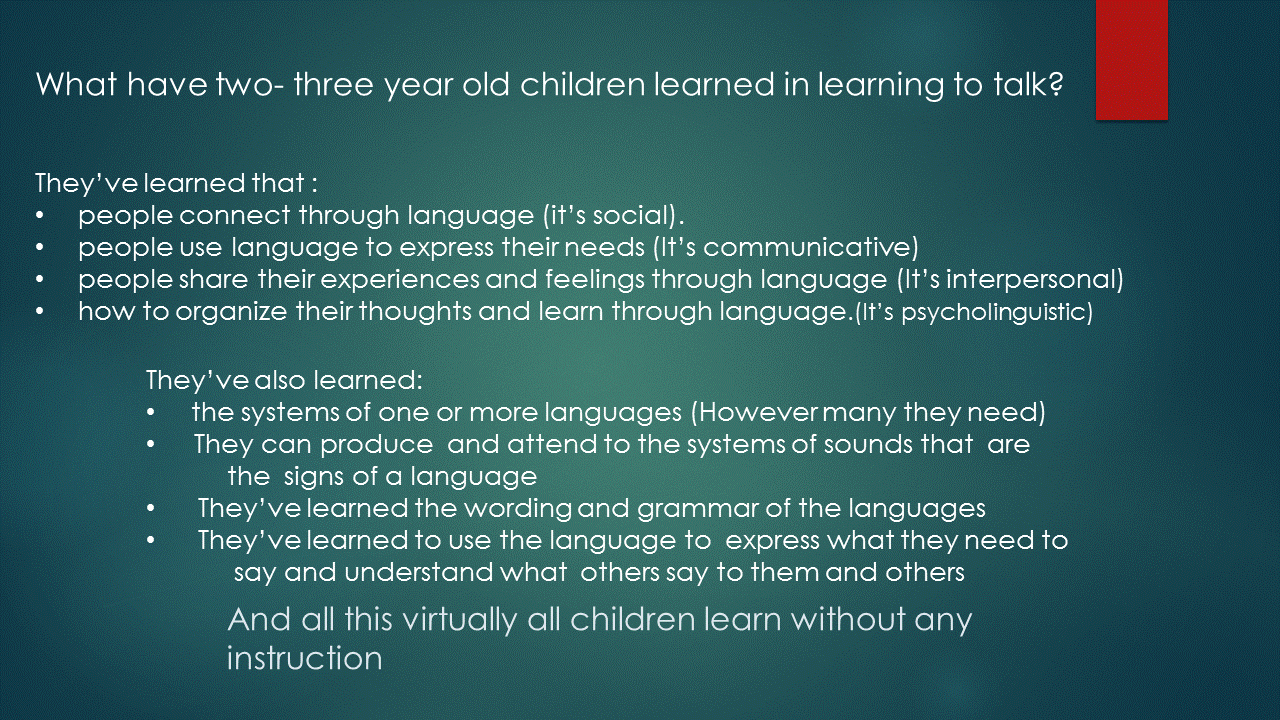
What have these 2-3 year olds learned?


They've learned that :

  • people connect through language (it's social).
  • people use language to express their needs (It's communicative)
  • people share their experiences and feelings through language (It's interpersonal)
  • how to organize their thoughts and learn through language.(It's psycholinguistic
They've also learned:

  • the systems of one or more languages (However many they need)
  •     They can produce and attend to the systems of sounds that are
the signs of a language

  • They've learned the wording and grammar of the languages
  • They've learned to use the language to express what they need to
say and understand what others say to them and others


But these children of the 21st century are also digital natives. Ezrial has a partly functional cell phone and with her mother's help writes me text messages. Juliette and Madison are masters of the Ipad and Levi's been talking into a toy cell phone since he could walk. We skype so often that the children have been somewhat startled to see us in person.
I mention this digital competence to introduce another important concept I have learned.
Written language is the inevitable extension of oral language. It comes about when our human need to connect is beyond the capacity of voice and ears. We need to connect over time and space. It's a parallel language system sharing grammar and vocabulary.
Written language is not a secondary representation of oral language. It is an alternate way of connection. It uses sight more than sound but it is language in every sense and it is no harder to learn than oral language in fact it is easier because it shares so much with oral language

There always have been children who moved into literacy easily and without instruction. My middle daughter Karen was reading before she started school. In a combined kindergarten first grade the teacher had kindergarten Karen listening to the first grade children as they learned to read. At home she lined up her dolls and read to them. The first article Yetta and I did together was on her spelling ability when she started kindergarten.
But now many more children are reading online and on mobile devices and merrily texting with their thumbs well before they start school.
Slide 7


The more complex society becomes the more we humans need to connect with each other. I've said elsewhere that Gutenberg's invention of the
printing press didn't make mass literacy possible rather the need for expanded literacy made the printing press necessary.
I'm briefly share some important things I've learned about how our species makes sense of print but I'll be coming back to this amazing ability of children to learn language and how that relates to them becoming literate.
Slide 8


Einstein has been quoted as saying that all scientific discovery begins with intuition.
Early in my research with miscue analysis I had such an intuition, I characterized reading as a psycholinguistic guessing game. At first I considered that a metaphor. But modern brain theory is confirming my intuition. Our brains are continuously predicting what will happen

It uses those predictions to tell the senses what to look for and where to look and it is selective about what it chooses to use from the sensory input. What I called psycholinguistic strategies in reading are general strategies of the brain. Reading is a very good example of the brain at work.


Now, in this digital ag, the functions overlap. Oral language can be preserved and written can be immediate as in texting. Reading as language then cannot have basic differences with how any language process works.

With this mind here are some key ideas we've learned about reading.


Slide9


Idea 1: Reading

is a process by which the brain constructs meaning from printed texts

.


Making sense and constructing meaning are two ways of saying the same thing
Reading is an active process in which meaning is created by the reader.
Though reading begins with the eye scanning the text to provide input to the brain. The brain specifically in the cortex is where meaning is constructed.
Slide 10


A common sense view is that the eye scans word by word and the brain then makes sense of the words. In that view accurate word recognition is very important and the letters in the words are used to identify the words.
But a century of eye tracking and half a century of miscue analysis has shown something quite different.
    About a third of all words are not fixated in reading. At times the eye regresses.
Words may be fixated but omitted in oral reading and words may be read in oral reading which were not fixated.
We've identified what we call the grand illusion in reading: Readers think they see all the words but they don't. The brain constructs perceptions based on visual input but also based on what it knows and what it expects to see.


What the reader thinks he/she sees is more important than what is actually seen. Prediction makes it possible for the eye to be selective in where it fixates. That's efficient because it saves time and energy.
Slide 11


Within our construction of meaning, the brain (specifically the cortex) predicts what the eye will see and constructs mental images based on the visual information but also on the predictions it has made. It only needs enough input to confirm what is expected or not and to make further predictions
It uses these perceptions to construct the wording and other features of the text. The brain actually constructs a mental text—we call it the reader's text—based on the published text. Remember what you are seeing as you read is not meaning but patterns of ink. You as the reader must construct from them a meaningful text and make sense of it. It is this reader's text which the reader comprehends.
There are two elements in how the cortex controls an ongoing process The lements are looping and corrective mechanisms. In driving a car in traffic or in reading, a series of decisions are continuously made; each maintains a connection between the cortex, the sensory systems, and the organs of the body. Each decision involves predictions on the basis of perceptions based on sensory inputs. But they also contain predictions of what is likely to follow.
Consider a few seconds of driving:
I'm driving in the speed lane but my exit on the motorway is coming up:
Cortex to foot: keep the foot steady on the accelerator but get ready to change lanes.
Cortex to eyes /eyes to cortex: check the mirrors for a break in traffic, start turning the wheel—whoa, where did that guy come from? Nice recovery, feet and hands!
Reading is much like that:
Cortex: message to eyes, eyes to cortex. Ready: hands on page: Initiate reading.     Eyes get me some input from left of line. Here's what we're looking for: quick few hundredths of second focus eyes. Thanks eyes: got a hunch of the pattern, predicting, wording, skip ahead now pretty sure what's coming…yeah we know what's coming—got the image yeah that's it. Understood! And here's what we're expecting. That's nice input—Whoa, eyes go back to the way this began—hold on—never mind I already know what it said..

 
Comprehending is this rapid continuous looping: sensing, thinking, muscle action: cortex makes sense. Occasionally the eye is sent back reversing gears to recheck input and then rolling on.

Idea 2: Any text—whether oral or written—is a complex system of abstract symbols with no intrinsic meaning.

And here is the miracle of human language: We are able to think symbolically—that is, use abstract symbols to represent meaning. We connect with each other, communicate our needs, our thoughts, our experiences, our feelings. But there is no meaning in the symbols themselves. The meaning cannot pass from one head to another. It is in the head of the writer who creates the text and the reader who makes sense of the text.
The meaning that we produce is never exactly the meaning the writer had—we all bring our own views and experience into the meaning construction. Poets particularly have understood this.

Idea 3: To make sense of what is read the reader must bring meaning to the text.

Both oral and written language texts have the potential to be understood. But understanding, to any degree, depends on readers bringing meaning to the text. We have it wrong when we say, "Does that make sense to you?" Rather, we should say, "Can you make sense of that?" We don't "get meaning" from the written text, we make our own meaning .By that we mean that the writer creates a representation of what he or she means but the writing itself is an array of abstract symbols that has no intrinsic meaning. If the text is well written, a reader who shares the language constructs meaning from it.
    Both the reader and the writer are trying to communicate through language. How well they succeed depends on two things:
    1. That they share the same language, at least substantially enough to understand each other. (Indeed they may share the same language but use it differently.)
    2. That the reader brings to the reading the background of knowledge and experience the writer has assumed the intended readers will have. The writer has a sense of audience.
Slide 12


Idea 4: Making sense of written language uses basically the same processes as making sense of oral language

.


Another common illusion is that it is necessary to first turn print into sounds (sound out) and then understand it as we do speech. In this view, written language is not real language but a code for language. But in our extensive research on oral reading miscues we found no evidence for that. We all read silently much faster than we speak. Rather, the two systems—oral and written language—are parallel. If reading were dependent on turning print to speech then deaf people lacking hearing could not learn to read. Deaf sign languages such as American Sign Language constitute a third parallel language system. The symbols are manual signs and they represent meaning directly just as speech and writing does. Sometimes people talk about "cracking the code" in reading. But language systems are all codes. The symbols have no meaning but in the systematic way they encode meaning.
Of course in listening you make sense of the language as you hear it. If you don't understand something in normal conversation, you can ask the speaker a question. In reading you can reread to get more understanding. In both cases, though, both thought and language are involved.
We use language to represent ideas. Whether the input is oral, written, or sign. We construct our own meaning in comprehending what is being said. And we are not limited by speech in how we can connect with each other.
    In any case, there is an ongoing transaction in which meaning is expressed in language and comprehended from language. So in reading, the text the reader comprehends is the text the reader is constructing parallel to but not identical to the writer's text. It is no longer just the writer's text, the parallel text is based on what the reader perceives, knows, believes, and understands. So what is comprehended will be a composite of author's and reader's meaning. Exactly the same thing happens in listening. The listener is also constructing a personal text and that is what is comprehended. So when a husband insists that his wife said one thing while his wife insists she said something else, they are both right since what they understood were two different but related texts.

Idea 5: How well any reader can make sense of anything that is being read depends on how efficient and effective the reader is and what they knew before reading.

An effective reader, like an effective listener has a good understanding of what is being said. But efficiency is a matter of how much time and energy the reader must expend to make sense.
Efficient readers use the least amount of time, energy, and cues from the text to make sense of what they are reading. Research has shown for a long time that there is a correlation between the speed of reading and comprehension. That has led to the mistaken notion that if we teach readers to read faster their comprehension would improve. Fortunes have been made from speed reading courses.
However, it isn't speed but efficiency that is related to comprehension. Efficient reading is relatively fast. That's because the reader uses the least amount of cues from the text, selectively, to make sense of what is being read. But proficient reading is always a combination of how efficient the reading is and how effective. Proficient readers are also flexible—they vary the speed at which they read to suit the density or the quality of the text, speeding up when the going is easy and slowing down when they need to use more cues from the text to get to the meaning (even rereading when the reader is unsure of the meaning). And many readers read more slowly or reread when they relish the text they are reading.
The general admonition of teachers is to read carefully. But reading efficiency will vary depending on the nature of the text, the purposes for reading and how predictable the text is for the reader. So efficiency and effectiveness are not general attributes but specific to each transaction between a reader and a text.    
Each of us is illiterate to some extent. We read some texts with great efficiency using fewer fixations, sampling the text very effectively, making highly successful predictions. And there are other texts that we have to read ploddingly and repetitiously to get some tentative sense of the meaning. In texts of great interest to us we bring the necessary background to fit ourselves into the intended audience it is written for. When I have to sign an important document such as a mortgage agreement, I get a lawyer to do my reading for me.
So let's come back now to what all this means for how teacher support literacy development.
Consider one eight year old child. Now finishing third grade, he had been subjected to DIBELS from his first day in kindergarten, He was thoroughly convinced that he was a non-reader because nothing worked for him. He was indeed a non-writer because all his time was spent on being tested taught to the test and then retested with DIBELS,
DIBELS is a test funded by the US Department of education developed at the University of Oregon by a group of direct instruction advocates who were put in charge of determining what states could put in their funding proposals under NCLB. That meant that without review by state and local authorities it was mandated in many states for all k-3 students.
Slide 13 and 14


The sub tests purport to test the five big things in reading according to the findings of the National Reading Panel, Each of the sub tests is given one to one preferably by someone other than the teacher on the school staff. Each test is timed at one minute and the child has three seconds to respond, Only correct responses are counted, each test is considered prerequisite to the next. Only the last of the five is a connected "story" and it is scored by the number of words read correctly in one minute.
After some pressure from teachers a retelling was added but the score is the number of words used in the retelling.
At one point this boy became so agitated by the time pressure of the test that he knocked the timer off the desk and left school and walked all the way home.
Now comes the happy ending. A neighbor began tutoring the young boy using retrospective miscue analysis. That's a process where he reads orally a story or article which is recorded. Then his tutor selects some of the miscues starting with those that show some evidence of some success in constructing meaning. In the short period of four months the boy began to be more comfortable in trusting his own learning and letting go of the nonproductive strategies he'd been drilled on. He had indeed been learning all the time he was in school and through the RMA sessions he began to revalue himself and the reading process. At school the DIBELS instruction continued but now a reader he even did better on that- his grades improved and his teachers noting the progress attribute to the success of his school instruction. But they told the tutor that he had the bad habit of making "educated guesses" and would need more instruction to get him to stop doing that.
I've told this sad story because it illustrates the great irony that the more explicit and virulent instruction becomes the more it interferes with the language learning children are capable of accomplishing on their own.
On teaching and learning of literacy 

Slide 15


Let's consider what are we teaching if we teach kids to read and write? We should be trying to support their learning to do what readers and writers do.
And let's consider how children- virtually all children learn language at a tender age without our help.: through the dialectic of invention and convention. They invent their language as they try to connect to those around them but they are constrained by the language others are using to communicate among themselves and with the child.
This dialectic is very productive because the universal ability to represent things, ideas, experiences feelings symbolically is also the way the brain organizes what if learns and remembers. The oral and written symbols move from random to those effective in connecting with others and the grammatical structures and morphology or wording of language are learned at the same time- since grammatical designs and morphemes must match and be assigned at the same time. Since what the child is learning: connecting through language the social conventions shape the inventions and they move closer while the grammar and lexicon grow together.


The ability to think symbolically is totally flexible and recursive, Signs can change their values in the same unit and signs can represent signs. As complex as the system is it is easy to learn because the brain works in much the same way.- organizing what it learns and storing the patterns that it creates to store and learn meanings.
Linguists understand that natural languages only exist as they are used in some context for some purpose and that the functions are processes and not isolatable skills.
From this it follows that language is universally developed and continues to be developed in the context of its use to connect people.


While language can be studied as any dynamic system can be studied. It cannot be learned by deconstructing it into pieces or constituents like pieces of a jig saw puzzle
This understanding of how language is learned leads to a conclusion others have discovered. The role of teaching is to support and facilitate learning in the context of using language to connect.
Furthermore this natural way of learning while using language is going on continuously
regardless of how young learners are taught.
Now let's compare this with the almost universal view that reading and writing are school subjects, that written language needs to be broken down to its components- building on the smallest and moving toward the largest. Reading then becomes learning part by part and bit by bit, letter by letter, word by word, rule by rule, skill by skill.


While young children are remarkably able to learn language, they are notably much less able to deal with abstraction. No wonder then they do not succeed well in learning sets of abstractions which not only are what they are taught but which are reified as reading in their tests.
Every attempt to create a scope and sequence for learning to read and write- what must be learned in each grade or as prerequisite to further learning is arbitrary and is likely to interfere with learning rather than support it. Fortunately most children will learn anyway though some will doubt their success and others will come to consider what they are taught more important than what they are learning themselves. Even when they are successful they think they have somehow cheated in making sense the wrong way.


Reading from the point of the school is what the tests test and the fact that a child is reading is not valued – what is valued is performance on the tests. Reading then is not making sense of print it is moving through an instrructional sequence and pasing tests.


Though I gave you an extreme example of dysfunctional instruction, it is the logical extension of what happens when the instructional program is reified as reading, It reaches the level I call the pedagogy of the absurd.


Vygotsky understood that language is learned in its use. Frank Smith has his 12 easy ways to make learning to read hard and one hard way to make it easy: Find out what the child is doing and help child do it. With informed teachers who understand what reading and writing are and how they are learned, every child can learn easily and effectively.


Then the role of the teacher is to provide challenging experiences in school that will expand on the growing literacy and produce more critical readers and more effective writers.
Happily children with access to digital devices, wherever and whoever they are, are finding their way into literacy much as they have found their to oral language as they use it to connect with their peers.
And predictably they are told when they arrive at school to put away their cellphones and tablets and get ready to be taught to read and write.
Slide 16


Responsive teaching for Literacy
  • There is no sequence of skills in literacy development
  • Reading and writing are not school subjects
  • Like all language literacy develops in the context of its use
  • Digital natives are already developing literates before they come to school:
  • Teachers need to build on what learners are naturally doing and provide access for those that haven't had it
    • Provide access to materials and experience of literacy
    • Immerse in literacy activities
    • Accept and build on texting and email
    • Plan literacy activities that expand need to read and write
  • The Double Agenda
    • Students are focused on what they are doing with written language
    • Teachers are monitoring both what they are doing and how they are doing it
  • The key is to support learning and avoid teaching anything which is at cross purposes to that learning or has to be unlearned